Here are three relatively interesting hypertrophy articles sent to me by my friend Vijay:
Strength Training: Overloading to Increase Muscle Mass
http://www.pponline.co.uk/encyc/strength-training-overloading-to-increase-muscle-mass-40882
Serious Strength Requires Serious Training:
http://www.coachad.com/pages/Powerline-Serious-Strength-Requires-Serious-Training.php
The Mechanisms of Muscle Hypertrophy and Their Application to Resistance Training: http://img2.timg.co.il/forums/1_158907702.pdf
Monday, April 28, 2014

Monday, April 7, 2014
Article: Shock-absorbing 'goo' discovered in bones
Here's a brief article about a recent discovery, that bones have a water-and-chemical-citrate 'goo' substance that seems in between the crystalline matrix of the bone. This is very interesting for a bone-plasticity point of view.. the living bone-matrix is a very alive and changeable thing - as I have blogged about HERE, before.
See HERE for the mini-article summary.
And HERE for the scholarly article.
Article: Embodied knowledge and bodyweight training
I read this short article the other day.. great little piece with some similar themes to the ones I discuss on this blog. See HERE.
[http://www.startbodyweight.com/2014/03/embodied-knowledge-and-bodyweight.html]
Saturday, April 5, 2014
Physical Alchemy: Basic Strength Training (Structural, Constituitional and Fundamental factors)

Physical Alchemy: Basic Strength Training
Dave Wardman
Strength training is a strong (somatic) medicine for our bodily un-aware culture. Not many people view it as such, but my observation and research over the passed decade and a bit (the last 7 years in particular) have lead me to view this as being very much the case. It is more than just 'getting stronger', 'bulking up' or 'getting ripped'; and so on.
When used well it can have a very powerfully positive effect upon the bodymind. When abused, it can have an equally powerful, inverse effect. The mistake is in the viewing of physical training as just 'going to the gym/getting fit'; and as being somehow separate and unrelated to the totality of ones' life, more generally.
Putting on muscle, getting fit or losing body fat is no problem (having an aesthetic or fitness primary objective); is often great, in fact - it is just somewhat wasteful of something that can do this (easily) and much more (physical cultivation primary objective); if you are skillful in the implementation and programming.
Many of the common primary goals people have for their use of strength training are not primary objectives for Physical Alchemy: aesthetics; performance (in sport or physical activity and/or towards advanced strength work); fitness (general).
[ Further see also 'Dynamic Health' and 'Demonstrating Strength vs Building Strength' by Steve Maxwell ]
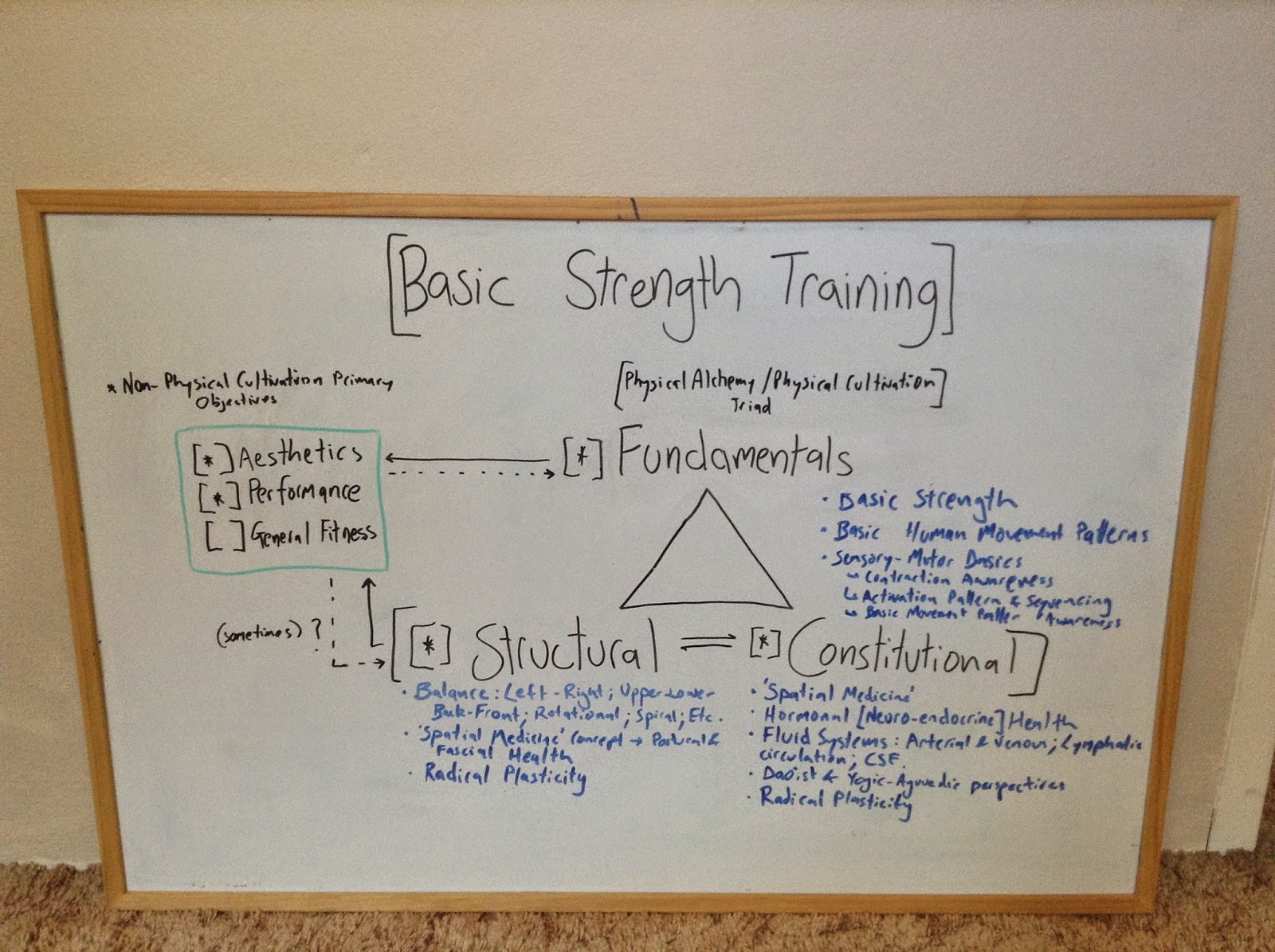
Basic Strength Training from a Physical Cultivation perspective
Basic Strength Training in the Physical Alchemy method is largely for structural (correcting imbalances of strength, contraction coordination and activation); constitutional (using methods to improve health in preference to fitness or performance - unless there is a good reason to preference differently) and fundamental (providing the base strength levels and patterns needed to work on higher level complex movements) benefits.
Two of these categories (Structural and Constitutional) fall into health cultivation and longevity (both quality of movement and vitality into old age; and length of lifespan). For people who are not performance based athletes, these two aspects can make up the bulk of the 'why and what' to train for.
The illusion that athletes (because they visually appear as fit/muscular specimens of humanity, and fit certain cultural ideals) are healthy is something that needs to be stated. Performance passed a certain level is depleting upon the vitality of the body (except, apparently, in swimmers - where it confers added lifespan. That tidbit I picked up off Steve Maxwell, and it is interesting to contemplate the mechanisms behind this..)
Fundamental strength work facilitates quality of movement learning and adaptation in chosen complex movement patterns (movement arts, martial arts, sport, games, play); as well as providing resilience/injury proofing and reducing physical demands of some activities. This can also be explained in reverse; if you lack basic strength-awareness (generally and/or in specific key areas and patterns) your body will find a dysfunctional way to complete the movement pattern you are asking it to learn. Various injuries, dysfunction and tissue damage result. You see this all the time; it is almost the rule, rather than the exception to it (sadly).
Using strength work in harmonious combination with the practice of complex movement patterns (movement arts), soft body skills and flexibility work is the primary goal at Physical Alchemy. The emphasis here is on basic. Many of the strength exercises popular at the moment have a moderate to high degree of strength-skill attached to them, and their transferability quotient is debatable (and IS debated, endlessly, across the Internet).
[*] Diminishing Returns
This raises the concept of Diminishing Returns. At what point does the amount of time-energy put into Basic Strength Training reach a point of diminishing returns in relation to health and skill increase in chosen complex movement patterns (i.e resources could be siphoned off into more skill training for the chosen complex movement art)?
There are many factors to this question: the individual's constitutional and genetic-biological makeup; the training age of the person; the complex movement pattern(s) being studied; the totality of stressors (physical; mental-emotional; environmental; viral; economic; temporal; etc) effecting the bodymind; the attributes already present (where they are with strength, flexibility and agility); whether the person is emotionally dependent on physical training; and on and on.
IF strength training is not an end in itself for the person (and it can be, which is what I would call 'Advanced' or 'Specialized' strength training); how much energy should you devote to it to maximize gains in terms of health and foundational aspects to aid other movement studies?
My answer.. you don't need so much, if you are doing it skillfully (balancing weakness; strengthening basic patterns; programming to aid the other movement activities). Then again, strength training is fun in and of itself - so I can see why people specialize in it (which is no problem; unless it is a problem). Problems creep in when people try to specialize at strength work at the same time as working on multiple complex movement patterns/arts (and working a day job; and having a relationship; etc)...
Classic signs of this occurring are the symptoms of over-training manifesting in the bodymind of the trainee. And I must say I totally understand how this occurs, and have done this myself, when I was younger. Strength training can be really fun and rewarding - especially when you start to get how it works well (training age and skill increases); it is mood-enhancing, confidence increasing - you get the increased somatic feeling of strength (the altered body-image from training) etc.. Also, complex movement patterns are great fun... so you end up in the gym 3-5 times a week; training for martial arts or whatever is 3 nights a week (sometimes more), and nobody's paying you to work out (unless you're lucky!) so you need a job; etc.
The body, more or less, takes all these stress as combined. The view that the whole of your life situation is somehow separate from your training is the downfall of many. The Stress of Life (as Hans Selye put it) is digested whole.
For some decent information on over-training, there is a section in Science of Sports Training on this that goes into much more detail than normal (Science of Sports Training - Thomas Kurz) - especially in regards to the differences between basedowic and addisonic overtraining; and strategies to overcome these. I did a brief overview of these 'yin and yang' types of over-training HERE.
Expanding the Structural, Constitutional and Fundamental factors a bit more:
[*] Structural
This refers to the use of strength training methods (in combination with Soft Body Skills (Flexibility; Stretching; Deep Physical Relaxation; RollStretch; etc) within a Spatial medicine (Structural Integration/Osteopathic/Daoist fusion) approach the the structural health of the bodymind.
One of the major things I seek to do with basic strength training is balance any imbalances in the soft tissues of the body (muscles, fascia, nerves): Left-Right; Back-Front; Upper-Lower; Rotational and Spiral Patterns.
In the Physical Alchemy method we utilize both classical-reductionist (especially Janda's work) and more pattern-based (Anatomy Trains/Myofascial Meridian; Chinese Meridian-organ channels and a few other perspectives) anatomy in the application and theory.
Using a combination of reductionist isolation work with integrative work is a useful thing to do, IMHO. Some muscular structures appear to perform a 'keystone' function and confer wide benefits upon the organism from their awakening (sensory awareness), strengthening and activation.
There is a fair bit out now about this type of thing.. I really like(d) Tom Myers (Anatomy Trains (KMI) & Fascial Fitness) take on this, in his Spatial Medicine concept - mentioned above (there was a great article on the old AT site, but it no longer works..alas).
Ido's (Portal) facebook page had a great little diagram (See HERE) showing: Isolation --> Integration --> Improvisation. This is a great way to look at it.
This aspect concerns, not just range of movement available (and other quantitative physical measurements), but also the texture, tone-responsiveness and 'health' of the soft tissues of the body.
What we are after is Optimal Responsive Tonus - a myofascial (soft-tissue) matrix that has lines of tension balanced; is relaxed when at rest (reduced 'parasitic tension' in the body), and is neurally responsive (so that you can leap into action at any given time and from any given posture - then return to rest).
[*] Constitutional
As I said, I utilize basic strength sessions in a Spatial Medicine way, as well as (more conventionally) for hormonal (neuro-endocrine) health; health of the fluid systems (taken generally to all fluid systems - and the prevention of stagnation in these systems - not just the heavily focused upon (and obviously important!) arterial and venous systems; but the lymph and cerebrospinal fluid too (what does strength and movement work do to the CSF, anyway?!); interactions and movements within organ-systems; lean muscle mass and the (re)-ignition of the Radical Plasticity of the body.
Training is a stress on the body. By intelligently programming our training in various ways we can (hopefully) force adaptation in a desired direction via supercompensation (if adequate food; rest; rejuvenation; etc..). If we focus on purely numbers (making 'x' reps) or competition, we often lose awareness and quality for sake of quantity and 'glory'. Training should make the body adapt in a favorable direction in terms of health. Performing thousands (tens of thousands..) of repetitions of faulty, low quality repetitions is giving the brain a lot a poor quality 'neural-movement food' to digest.
[*] Fundamental
Many people are far too weak. Too weak for the activities they undertake. Too weak for the activities of daily life, in some cases. What I mean by this is they have to compensate in a posturally poor, mal-adapted way to a given movement; due to lack of strength and/or poor basic locomotion and movement patterns.
Many of these people want to go out and take on complex movement patterns that are beyond their current capacity. This is where basic strength training comes in, and it is one of the best uses for basic strength training (and you'll likely put on some lean muscle mass, too).
Basic Strength Training is just this; the basic strength attributes to lay the foundation for complex movement patterns (even simple movement patterns!). It provides:
• Basic Strength and Lean Muscle Mass
• Basic Human Movement Patterns
• Sensory-motor Basics: Contraction (muscular) awareness; activation pattern and sequencing; basic muscle group and movement pattern awareness.

Other common primary goals for strength training not emphasized in the Physical Alchemy method.
[*] Aesthetics
Whilst having this as primary outcome for training can have a certain narcissism to it, the isolation work and seeking a balanced symmetry in musculature is not without some merit (I refer here more to the golden age of bodybuilding).
As mentioned above, certain specific activation-hypertrophy-strengthening of key 'asleep' muscles groups can be a wonderous thing - if brought to life by re-intergration into larger, more global movement patterns. Common spots for this are: forearm and hand muscles; feet and foreleg; neck training; deep anterior spine muscles; glutes; and a few other areas.
Aesthetics should flow out of correct Basic Strength Training in a Physical Cultivation configuration (and a certain degree of non-attachment present in this).
[*] Performance
Just to things clear, the Physical Alchemy method of Basic Strength Training is not about pure performance enhancement (especially competition training for sports), but is the use of strength work within a physical cultivation parameter.
Performance will definitely improve (to a point) from training to improve the Structural, Consitutional and Fundamental aspects mentioned above - but at the higher levels performance will eat in to your health.
And there is no problem with this if your passion in life is to perform at a competition level in whatever movement activity you chose (some activities being less effecting of health; some more). We all gotta go sometime; no point living to 100 having never really lived with aliveness.
There are many examples of great people who burned quick and bright, and positively influence thousands (or millions) with their legacy (on of my favorites being Bruce Lee (of course)). [ See Kit Laughlins blog HERE for more insights on this ]
Methods
I have a preference for certain modes of training (as do most trainers). I will steer clear of too much 'one true way' methodology, in terms of 'best' methods. I personally love minimalist training because it is practical, fun and has an 'agile-lifestyle' vibe about it. It's also effective for my non-elite performance physical cultivation training framework - and easy to give to people to do at home (without them spending a mint on equipment that gathers dust in the corner).
I utilize largely exercises from the Monkey Gym Syllabus (which I helped create); the methods of Steve Maxwell; Stretch Therapy methods; physical conditioning methods from martial arts (especially Chinese and South East Asian martial arts) and various other exercises I have created.
Exercise is a large part body-weight; with some kettle-bell lifts (especially the strength-stretch and multi-plane movements: TGU; Side press; Windmill; etc) and gymnastic holds; some clubs and band work, too. I have nothing against other methods (barbell; strongman; etc), I just do not personally specialize in them and would rather refine what I already do.
As I have been mentioning throughout this piece; the strength work is kept basic in Physical Alchemy, so that there is high remaining energy to work on complex movement patterns from movement arts - because these are much more fun; offer higher level benefits and are more life-enhancing in my opinion.
* Ok; so maybe the Farnese-Hercules image at the top is not 'Basic' strength training - but it is a great statue.
Tuesday, April 1, 2014
Coffee - Modified 'Nityananda Spices' w Coconut Cream

Coffee - Modified 'Nityananda Spices' w Coconut Cream
So, I tried (and succeeded!) going cold turkey from coffee for about 10 days. There was some protesting, but it wasn't too hard. Now, I am having one a day, and not every day. The method I have been trying at home is very tasty, so I've decided to blog about this simple concoction. It is a modification of a recipe that Kit Laughlin shared with me - the Nityananda herbs (spices).

Shown are the 3 herbs (spices) of the blend: Cinnamon; Cardamon & Nutmeg. Also shown is a great little grinder I inherited from Kit (thanks man!). I haven't actually be grinding beans for the last few coffees, as I have some cheap packet coffee I am using up.

So, I pack 3 and a half scoops of coffee into the coffee-pot (in respect to the 3 and half times the kundalini is coiled at the base of the spine, of course..).

Post ~15 second extraction (shown as title picture), I add some coconut cream. Shown is the brand I found in the cupboard this time.. I think the best one I ever did used the Aroy-D brand of coconut milk/cream.

On top of the this brew, you add the three herbs. Largest portion cinnamon; next largest is nutmeg - and a sprinkle of cardamon (change up for your preference).

Done. I made one that looked much prettier (and was delicious) but didn't get a picture. The above one was still far better than many I have paid for that used highly expensive coffee machines, so goes to show you can make great coffee with low-tech equipment.
Thanks to Kit for sharing the secret 'erbs with me; and to Tanya, who I believe suggested coconut cream to me in my coffee. :)
Friday, March 28, 2014
Guest Blog #1: Yoga - Vijay Panchia.
I count myself blessed to know, and count as friends, a fair number of other people on the path; humans into the same type of things I am interested in, here at Physical Alchemy - but approaching it from their own unique viewpoint, and with their own skill-sets and teachings.
I would like to feature these people on my blog; getting them to distill an aspect of the knowledge base that they specialize in, or, an insight they have gained from training. That type of thing. I am really looking forward to this myself, as I will learn much from my peers posts.
So, without further ado, my inaugural Guest Blog post is by my recently gained good friend and fellow explorer Vijay Panchia.
I met Vijay at the Steve Maxwell Mobility Conditioning Seminar that I reviewed a number of posts back. Our initial conversation jumped around all types of interesting things: movement training; physical cultivation; Thai, Burmese, Indian, Chinese and Brazilian martial arts; Dharma; sanskrit (which Vijay studied at Oxford); shaivism; various types of obscure (but awesome) strength training methods - you know, all the same stuff I like. It seems somewhat inevitable that we would meet.
The guest blog post for today is a general introduction to the word yoga. I had to stop Vijay from writing a mahabharata-esque epic, so I am hoping to get him to expand upon a number of things in future posts.


Something that really needs to be made clear about Indian thought is that it is an open conversation where one does not have to agree with everything in a text. However you need to well versed in order to engage in this ancient dialogue. Indian systems more often than not are based on logic and experience, hence dogmatic practice is a misdemeanor. Also I would like to say that being well versed in these Yoga texts does not make you a yogi or yogini, and they may not even be necessary to achieve the elevation or mastery of the mind discussed. A big part, if not the most important aspect of transmission of this knowledge, is through the direct oral teachings of a master of these practices. To establish whether or not someone even is a master of this spiritual path, the knowledge from these texts may be very useful.

I would like to feature these people on my blog; getting them to distill an aspect of the knowledge base that they specialize in, or, an insight they have gained from training. That type of thing. I am really looking forward to this myself, as I will learn much from my peers posts.
So, without further ado, my inaugural Guest Blog post is by my recently gained good friend and fellow explorer Vijay Panchia.
I met Vijay at the Steve Maxwell Mobility Conditioning Seminar that I reviewed a number of posts back. Our initial conversation jumped around all types of interesting things: movement training; physical cultivation; Thai, Burmese, Indian, Chinese and Brazilian martial arts; Dharma; sanskrit (which Vijay studied at Oxford); shaivism; various types of obscure (but awesome) strength training methods - you know, all the same stuff I like. It seems somewhat inevitable that we would meet.
The guest blog post for today is a general introduction to the word yoga. I had to stop Vijay from writing a mahabharata-esque epic, so I am hoping to get him to expand upon a number of things in future posts.
Yoga
Vijay Panchia
What
is Yoga?
Is
it what we find in our local fitness clubs?
Is
it something of myths?
Is
it something only for Indian Holy Men?
Is
it a form of ancient gymnastics?
Or
is it something else?
When
confronted with writing on the topic of the yoga by my friend Dave, I had to
really think about what I was going to write about. It is a truly vast topic.
But before specific areas are covered I thought best that I express what yoga
is to me. You are entitled to disagree with what I have to say but this at least
gives a starting point.
Yoga
is a system or path for means of spiritual fulfillment or enlightenment. It
provides the practitioner with direct perception with the spiritual or divine.
There
are a multitude of physical systems in the modern western world that are called
yoga however few really present anything which can to be used to reach such
goals or at least accordance with what we find in early yoga texts.
The
earliest Vedic texts to make reference to such practices include the Upanishads,
the Mahabharata, the Bhagavad-gita (which is a chapter of the Mahabharata, more
often read isolation) and Yoga Sutras of Pantanjali. What is presented by such
texts could be said to be a practice of mental science or alchemy, where the
yogi distills the mind in order achieve his spiritual goal. There is no mention
of the acrobatic like postures and stretches that we see in the common
practices in the West.
What
are mentioned are the asana or posture of keeping the body, neck and head erect,
and the practice of pranayama or breathing exercises. These are the assistant
exercises for the yogi to his goal. No mention what so ever of being able to
put your legs behind your neck (not that I’m saying there isn’t any merit in
this). What is also interesting is there
is no detailed explanation on the practice of pranayama. The greatest emphasis is put on how one is to
think and perceive the world. One might
say “how to navigate the mind”.
This
way or path of thought is possibly best expressed or at least most accessible
by the teachings of Lord Krishna and his discourse with Arjuna found in the
Bhagavad-Gita. This is a masterful
teaching on the mind. He presents different paths of yoga, making accessible to
all some practice of yoga. It could be said he is presenting a single path of
yoga but giving various start points to fit with the aptitude of the
practitioner.
Rather
than going into the specifics of the Bhagavad-Gita, I would suggest tracking
down a good copy of it and reading it yourself. Everyone seems to take away
something different from it and it would be clumsy of me to even try to match
Krishna in a blog post. There are many translations of the Gita available and
all with have their own bias. The
Winthrop Sargeant translation is not a bad place to start and even has the
transliteration of the Sanskrit.
The
Yoga Sutra of Patanjali is the text often perceived as the quintessential work
on yoga and teaches the eight fold path refered to as Ashtanga. This is not
to be confused as a reference to the work of Pattabhi Jois. It is divided into
the four parts: Contemplations, Spiritual Disciplines, Divine Powers and
Realizations. Like many Indian works, it is intended be used along with direct
teachings of a guru, and does not provide a complete discourse on practice. It is very readable for the most part but be
wary that there are many translations of the text with much variance. With the
original Sanskrit, Patanjali has used very intricate and dense vocabulary.
Hence it is hard to give a recommendation to any single translation. But don’t
let this deter you from reading this work.
The
Upanishads are regarded as part of the Veda. The Veda is divided into four parts: the Rig, the Sama, the Yajus
(which comes in two forms, known as shukla and krishna, light and dark) and the
Atharva. Each of these four is in turn divided into four types of material,
which are the Samhitas, Brahmanas, Aranyakas and Upanishads. The Upanishads are
the philosophical discourse on Vedic philosophy, giving an explanation to the
nature of this world. There are many texts given the title of Upanishad however
it said there are ten primary texts which are based on commentary by Advaitan
Philosopher, Sankaracharya (AD 780 to 820). These “other” texts often deal
specifically on the topic of yoga, however as they are not primary sources and
from a much later date, I will leave them from this discussion. Of the ten
primary Upanishads, the Katha Upanishad and Shvetashvatara Upanishad offer the
most obvious statements on what we consider to be yoga. These are more
challenging works and some background knowledge or guidance may be necessary.

The
Mahabharata is the great Indian epic poem, much like the Odyssey and Iliad.
However the Mahabharata, being three times the size of the Bible, dwarfs these
great Greek works in size. Even more amazing this work is from an oral
tradition, meaning it was originally transmitted by being put to memory. The
original author attributed to this work is the Indian sage Vyasa, whom is said
to have split the Veda into its four divisions and authored 18 of the major
Puranas. It was written to summarize the
Vedic teachings. It is a story of the Pandava and Kaurava princes and the
rivalry and war that breaks out between these cousins. Various discourses are
given through out the text on yoga and the metaphysics behind it. One we have
discussed already is the Bhagavad Gita.
Something that really needs to be made clear about Indian thought is that it is an open conversation where one does not have to agree with everything in a text. However you need to well versed in order to engage in this ancient dialogue. Indian systems more often than not are based on logic and experience, hence dogmatic practice is a misdemeanor. Also I would like to say that being well versed in these Yoga texts does not make you a yogi or yogini, and they may not even be necessary to achieve the elevation or mastery of the mind discussed. A big part, if not the most important aspect of transmission of this knowledge, is through the direct oral teachings of a master of these practices. To establish whether or not someone even is a master of this spiritual path, the knowledge from these texts may be very useful.
If
one wanted to delve deeper into these texts I would like to suggest seeking out
the online courses offered by my friends at the Oxford Centre for HinduStudies. These are academic level courses put together by the brightest academic
minds on Hindu thought. They offer specific courses on the Bhagavad Gita, the
Upanishads and a general course on Yoga among others.
Useful links
Oxford Centre for Hindu Studies
http://www.ochs.org.uk
They offer online courses and many of the texts discussed. There is
also free mp3 lecture downloads on many of the different topics that
make up Indian Thought
The Bhagavad Gita - trans. by Winthrop Sergeant
http://www.amazon.com/
The Upanishads
http://www.amazon.com/
Very accessible translations of the ten primary Upanishads by scholar
Patrick Olivelle.
Sacred Texts
http://www.sacred-texts.com
A free online resource with translations of the texts discussed.
Yogas Sutra of Patanjali trans. BonGiovanni
http://www.starcenter.com/
http://yogavidya.com/gita.html
Offers a free pdf of the Bhagavad Gita as well as other early Hatha Yoga texts.
Spiral Movement Patterns, Rolling and 'Following The Eyes'
In case you missed it, Craig (ARC training) and Simon (Ancestral Movement) just released a new three video series on various movement patterns incorporating spiraling/rotating and rolling with the concept of eye lead movement (following the eyes).
These drills are totally cool and playful, and can be done just about anywhere. Simon is demonstrating them (on a miscellaneous patch of Earth in Canberra) as they should be done (or, as you should work towards doing them) - with smoothness, awareness and control.
They make a great warm-up; 'morning mobility' or movement-play session. Looking forward to more videos from my good friends Simon and Craig!
Videos below:
Spiral Movement Transitions part 1 - Rotating
Spiral Movement Transitions part 2 - Rolling
Spiral Movement Transitions part 3 - Following The Eyes
Subscribe to:
Posts (Atom)